The Post-Tournament Crash: How to Stop Bleeding Rank After Your Best Weekend

Photo by Photo by Stem List on Unsplash on Unsplash
Sunday night. You close out a tournament bracket with plays you didn't know you had in you. The chat is going crazy. Your team is celebrating. You feel like the best version of yourself — sharp, locked in, untouchable.
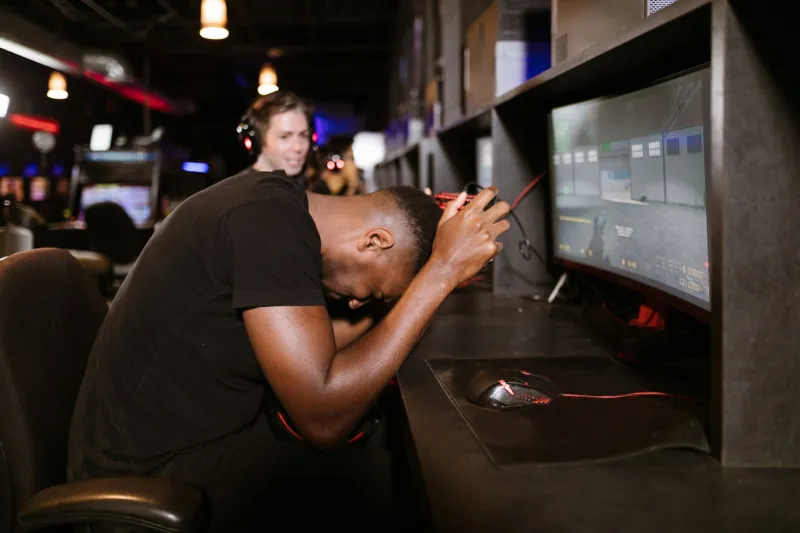
Wednesday. You're down 80 LP from your pre-tournament rank, playing like you've never seen the game before, wondering if Sunday was even real.
This isn't a confidence problem. It's not bad luck. It's a predictable physiological and psychological cycle that hits competitive players across every format, from local LAN events to major online brackets — and almost nobody talks about it until they're already in the hole.
What's Actually Happening in Your Brain
Tournament performance runs on a specific cocktail of neurochemicals. Adrenaline sharpens reaction time and narrows focus. Cortisol in controlled doses enhances performance under pressure. Dopamine floods the system with each win, reinforcing aggressive, decisive play. You're essentially running your brain at a hardware overclock state for 48 to 72 hours.
When the tournament ends, that neurochemical environment collapses. Cortisol, which was working for you under structured competition, now has nowhere to go — and chronic post-competition cortisol elevation is directly linked to impaired decision-making, reduced working memory, and emotional dysregulation. The same stress response that made you clutch a five-on-one now makes you misread a 2v2 and tilt after one bad trade.
Sports psychologists who work with esports athletes — a field that's grown significantly over the past five years — have documented this crash pattern extensively. The consensus is that the window between 24 and 72 hours post-competition is when players are most vulnerable to performance regression, and most likely to misattribute that regression to skill rather than recovery state.
The Confidence Inversion Trap
Here's where it gets counterintuitive. Tournament success doesn't just leave you physically depleted — it changes your psychological baseline in ways that can actively hurt your ranked play.
After a strong tournament run, players often enter solo queue with elevated expectations and lower tolerance for the chaos that ranked environments produce. You just spent a weekend playing coordinated, structured competition where calls were communicated and strategies were executed. Now you're back in a lobby where your support is running it down mid and your ADC hasn't typed since champion select.
The mismatch between your tournament mental model and the ranked reality creates friction that manifests as frustration, rushed decisions, and the kind of ego-driven plays that ranked punishes mercilessly. You're not playing worse because you got worse. You're playing worse because your internal standard shifted upward without your environment shifting with it.
Competitive coaches in the VCT and collegiate esports circuits have specifically flagged this pattern as one of the most common causes of post-tournament rank decay among their players. The solution isn't to lower expectations — it's to consciously recalibrate what "good play" looks like in an uncoordinated environment.
The 72-Hour Recovery Protocol
The players who successfully convert tournament momentum into sustained ranked improvement aren't the ones who immediately grind ranked to "lock in the feeling." They're the ones who treat the post-tournament window as a deliberate transition phase.
Hours 0-24: Full decompression. No ranked play. Seriously. The neurochemical environment you're operating in during this window is not conducive to learning or improvement. Any LP you gain is lottery-level variance; any LP you lose will feel catastrophic. Watch something. Sleep. Eat actual food. Let your nervous system reset.
Hours 24-48: Low-stakes review. This is the window for VOD review, not active play. Watch your tournament matches with a critical eye. Identify two or three specific decision patterns — good or bad — that you want to carry forward. This cements the learning from the tournament experience before it fades into emotional memory.
Hours 48-72: Controlled re-entry. Return to ranked with an explicit process focus rather than an outcome focus. Set a specific mechanical or decision-making goal for each session — something you identified in your VOD review — and evaluate your session against that goal rather than your LP change. This rebuilds the deliberate practice mindset that tournament adrenaline temporarily replaces.
Converting the Peak Into a New Floor
The real opportunity in tournament performance isn't the LP you can grind in the 48 hours after. It's the evidence you now have about your actual ceiling.
Tournament conditions — the preparation, the focus, the structured environment — showed you what your game looks like when everything is aligned. That's real data. The goal now is to systematically identify which elements of your tournament preparation you can build into your regular ranked routine.
Did you warm up differently before tournament matches? Sleep on a consistent schedule during the event? Cut out distracting inputs during your prep window? These aren't tournament-specific luxuries — they're performance conditions that you can replicate. Players who approach post-tournament periods this way don't just avoid the crash; they use the tournament as a benchmark to build a higher baseline.
The gap between your tournament peak and your ranked average isn't evidence that your tournament performance was a fluke. It's a map of the conditions that unlock your best game. Start building those conditions into your everyday grind, and the post-tournament crash becomes something else entirely — a data point on the way to a new normal.