Stop Playing Faker's Game: How Copying Pros Is Quietly Erasing Your Identity
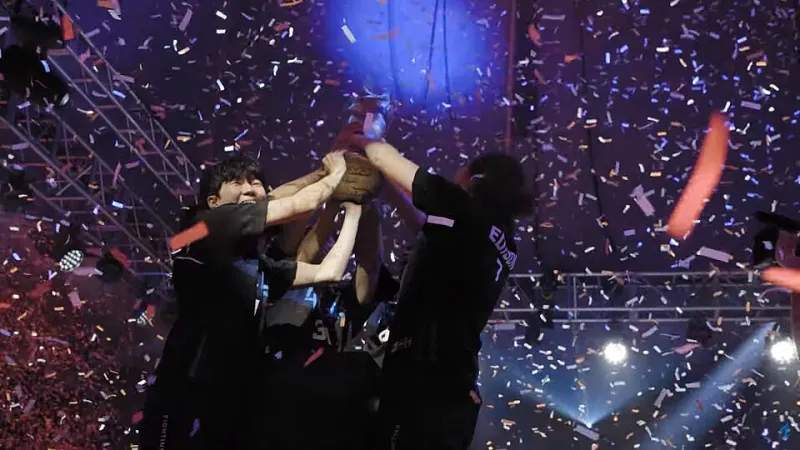
Photo: Dallas Fuel, CC BY 3.0, via Wikimedia Commons
There's a moment every competitive player knows. You watch a pro clip, maybe it's a Faker roam, a s1mple flick, or a Bugha build sequence — and something lights up in your brain. I want to do that. So you study it. You practice it. You run it in ranked until it feels like muscle memory.
And then you wonder why it never quite works the same way.
The answer isn't your mechanics. It's not your sensitivity or your hardware. It's that you're copying the output of a process you haven't done the work to build. That's the copycat trap, and it catches more aspiring competitors than any bad matchup or broken meta ever could.
The Iceberg Problem Nobody Talks About
Every pro play you see on a highlight reel is the tip of an iceberg. What you're watching is the final expression of thousands of hours of game knowledge, positional intuition, and situational reading that you can't see on the screen.
When Faker makes an aggressive mid-lane call that looks reckless, he's not gambling. He's solving an equation in real time — cooldown tracking, wave state, enemy jungler position, vision control — and arriving at a conclusion that only looks reckless to someone who can't read the same variables. When you copy the aggressive call without understanding the equation, you're not playing his game. You're playing a costume version of it.
This is where the trap gets dangerous. Blind imitation creates players who make the right shapes with the wrong reasoning. And in competitive play, reasoning is everything. Opponents at your level — especially anyone grinding ranked seriously — will start to read your patterns because your patterns aren't rooted in adaptive logic. They're rooted in habit borrowed from someone else's context.
Predictable players get punished. Every time.
Why Your Brain Loves the Shortcut
Here's the honest truth: copying pros feels productive because it is a form of learning. Watching high-level gameplay exposes you to decision trees and mechanical options you might never discover on your own. There's real value in that exposure.
The problem is when observation skips the translation step. Your brain sees the play, catalogs it as a winning move, and tries to store it as a solution. But solutions only work when the problem matches. Pros aren't running pre-scripted plays — they're running adaptive responses to specific conditions. You can't just paste the response into a different problem and expect the same output.
This is especially brutal in games like League of Legends, Valorant, or CS2, where team compositions, economy states, and map control create wildly different contexts every round. The play that wins in one situation loses in another that looks almost identical on the surface.
The Difference Between Mimicry and Extraction
The players who actually level up from watching pro content aren't copying plays. They're extracting principles.
There's a massive difference. Mimicry says: Faker walked mid at three minutes, so I should walk mid at three minutes. Extraction says: Faker walked mid at three minutes because the wave was frozen, the enemy jungler was spotted bot side, and he had a cooldown advantage. The principle here is that aggressive movement is justified when enemy response time is compromised and your cooldowns are up.
One of those frameworks helps you once. The other helps you in every game you ever play.
When you watch pro VODs — and you should watch them — train yourself to ask why before you ask what. Pause on the moment before the play, not just the play itself. What information did they have? What did they give up to gain that position? What would have made that call wrong?
That kind of analysis is slower and less satisfying than just copying a highlight, but it's the only version that compounds over time.
Your Style Is a Competitive Asset
Here's something the copy-and-paste mentality completely ignores: your natural tendencies are data.
The way you instinctively read angles, the aggression level you default to under pressure, the decision patterns you fall back on in high-stakes moments — those aren't flaws to be overwritten. They're the raw material of your competitive identity. The best players in any game aren't clones of whoever was great before them. They're evolved versions of themselves, shaped by the principles they absorbed and filtered through their own instincts.
Ninja didn't win by playing like someone else. Shroud's aim was his own. Even in traditional esports, the players who define eras are the ones who developed a recognizable style — something opponents had to specifically prepare for, not just generically counter.
If you spend your entire development phase trying to be someone else, you never find out what you are. And that's the real loss. Not the rank points, not the missed plays — the competitive identity you never built because you were too busy borrowing someone else's.
A Framework for Learning Without Losing Yourself
So how do you actually do this? Here's a practical approach that works:
Step one: Watch for patterns, not plays. When reviewing pro content, look for recurring decision logic across multiple games, not individual highlight moments. If a player consistently makes a certain call in a certain type of situation, that's a pattern worth studying.
Step two: Test the principle, not the play. Take what you extracted and try to apply the underlying logic in a situation that matches the conditions, not just one that looks similar on the surface. If it works, you've internalized a principle. If it doesn't, figure out which variable was different.
Step three: Build on your strengths. Identify two or three things you already do well and look for pro players who excel in those same areas. Study how they developed those strengths, not how they play overall.
Step four: Break your own patterns. Periodically review your own gameplay with the same critical eye you apply to pro VODs. Where are you running on autopilot? Where are your borrowed habits showing up as liabilities?
The goal isn't to stop learning from pros. The goal is to learn through them instead of from them. There's a version of you that can outplay, outthink, and outlast — but only if you actually build that version instead of renting someone else's.


