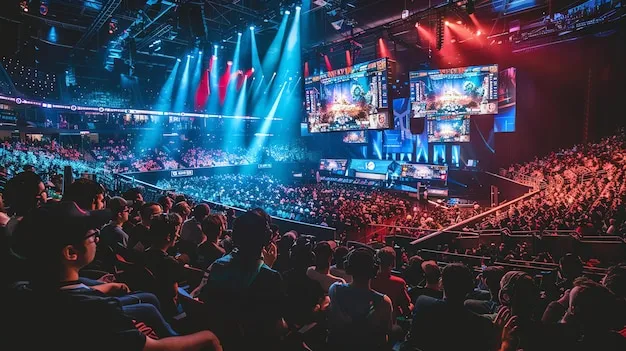
Ten Thousand Eyes Watching: The Invisible Pressure That's Breaking Streamers in Tournament Play

Photo by Photo by ELLA DON on Unsplash on Unsplash
There's a moment every high-profile streamer knows. You're deep in a tournament bracket, the match is close, and your chat is moving at 400 messages per second. Someone donates with a message you can't help but clock. Your clip from two rounds ago is already being ripped and posted. And somewhere in the back of your mind, the awareness that thousands of people are watching you — judging every decision in real time — starts to seep into your focus like water through a cracked foundation.
This isn't a personal failure. It's neuroscience. And it's quietly costing some of the most talented players in North American streaming culture their best performances at the worst possible times.
The Science of Being Watched
Researchers have studied the effect of audiences on performance for over a century, and the findings are genuinely complicated. The phenomenon known as social facilitation — first documented by psychologist Norman Triplett in the 1890s — suggests that being observed can actually improve performance on well-practiced tasks. But there's a catch: for complex tasks that require conscious decision-making and adaptability, an audience tends to hurt performance.
Competitive gaming, especially at a high level, is absolutely a complex task. The decisions you make in a tournament match — rotations, resource management, reading enemy patterns — require the kind of flexible, high-bandwidth thinking that tanks under pressure.
Dr. James Okafor, a sports psychologist who has worked with esports athletes at the collegiate and semi-professional level, explains it this way: "When you add a large, reactive audience to an already high-stakes environment, you're essentially asking the brain to manage two competing attention systems simultaneously. The competitive task and the social performance. Most people can't do that cleanly, and the part that suffers is almost always the competitive task."
For streamers, the audience isn't just present — it's interactive. Chat reacts to every mistake in real time. Donations punctuate tense moments. Clips get made while the match is still live. The feedback loop is immediate and relentless in a way that no stadium crowd can replicate.
When the Chat Becomes the Opponent
The cases aren't hard to find if you follow the streaming and tournament scene closely. During several high-profile invitational events over the past few years, prominent streamers have made decisions mid-match that looked baffling in context — overly aggressive pushes, bizarre utility usage, hesitation at critical moments — only to address it afterward on stream by referencing how distracted they felt.
One pattern that comes up repeatedly is what psychologists call self-presentation anxiety: the fear of being perceived negatively by an audience shifts your decision-making from "what wins this round" to "what looks good on stream." You start playing for the highlight clip instead of the W. You avoid the safe, boring play because boring doesn't clip. And in a tournament bracket, boring plays win matches.
Content creator and semi-pro Valorant player "Kestrel" — who asked to use their handle rather than their name — described the experience during a charity invitational that drew over 80,000 concurrent viewers: "I caught myself checking the chat reactions after a duel I won instead of immediately repositioning. It was like a half-second where my brain went, 'Did they like that?' And I got punished for it. My opponent had already moved and I was standing still thinking about my chat."
That half-second is enormous in a game measured in milliseconds.
The Compartmentalization Problem
The standard advice for managing streaming pressure during competitive play is compartmentalization — mentally separating your "streamer brain" from your "competitor brain." In theory, this makes sense. In practice, it's one of the hardest cognitive skills to actually develop.
Professional players who transitioned from traditional competitive rosters to streaming careers describe a genuine adjustment period where the two modes of operation actively conflict. On a roster, your only audience is your coach and teammates. The mental environment is sealed. As a streamer-competitor hybrid, you're essentially an actor and an athlete simultaneously, and those roles have fundamentally different psychological demands.
Dr. Okafor points to attentional bandwidth as the core issue: "Every streamer has a finite amount of cognitive resources available during a match. The more of that bandwidth gets allocated to audience management — reading chat, performing for viewers, managing the stream experience — the less is available for the actual game. Top players who handle this well have essentially trained themselves to treat the chat as environmental noise, like crowd noise in a stadium. It's there, but it's not data."
The players who do this best tend to share a common habit: they aggressively limit their chat engagement during active gameplay and build rituals around match preparation that mentally signal the transition from streamer mode to competitor mode. Pre-match routines, chat-off periods, and deliberate focus cues all serve the same function — drawing a hard line between the performance space and the competitive space.
Building a Wall Between Chat and Competition
For streamers who compete seriously, the practical toolkit for managing this pressure borrows heavily from traditional sports psychology:
Routine-based state shifts. Many athletes use specific pre-performance rituals to trigger a focused mental state. For streamers, this might mean a defined period before a tournament match where chat is minimized, music goes on, and the stream becomes a broadcast rather than a conversation.
Outcome detachment during play. Focusing on process — the next decision, the current round — rather than how the match looks to viewers. This is easier said than done, but deliberate practice in lower-stakes streams helps build the habit.
Post-match processing windows. Rather than reacting to chat immediately after a loss, giving yourself a defined period to decompress before engaging. Streamers who jump straight into chat reactions after a tough tournament exit often spiral emotionally in ways that affect their next match.
Honest self-assessment. If streaming pressure is genuinely affecting your competitive performance, acknowledging that openly — to yourself and your audience — removes some of the hidden weight of it. Several streamers have noted that simply telling their chat "I'm going heads-down for this one" creates a social contract that reduces the pressure to perform for the audience.
The Audience Isn't Going Anywhere
Here's the complicated reality: the intersection of streaming culture and competitive gaming isn't shrinking. More tournament formats are built around streamer participation. More prize pools are attached to events where the competitors are also content creators. The pressure of the live audience is a permanent feature of this landscape, not a bug that's going to get patched out.
The players who figure out how to compete under mass observation without letting it eat their focus are going to have a massive edge. That's not a mechanical skill you can grind in an aim trainer. It's a mental skill that gets built through experience, self-awareness, and the willingness to do the uncomfortable work of examining why you threw that round when ten thousand people were watching.
The chat will always be there. The question is whether you're playing the game or playing to the chat.